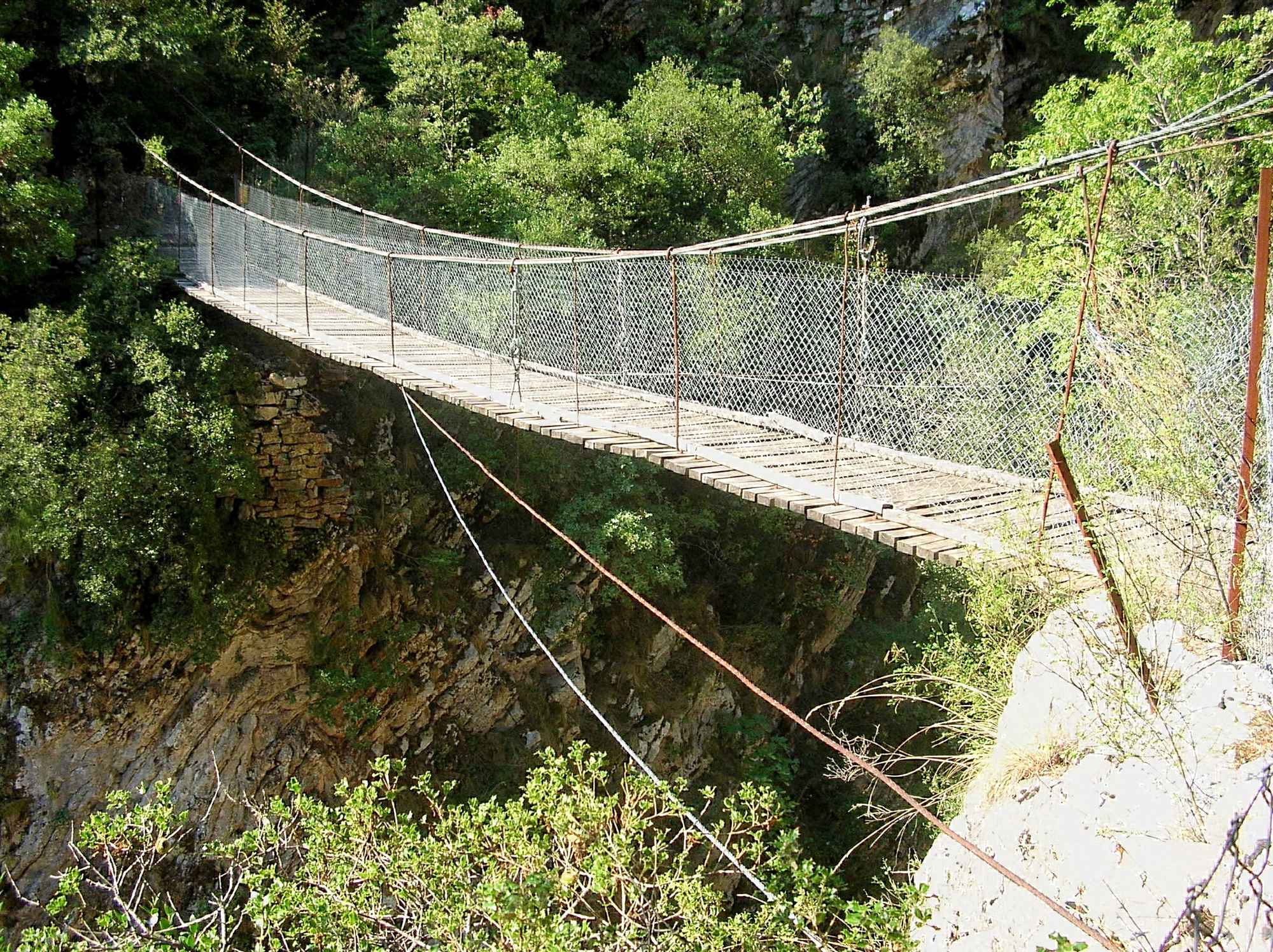
Kakogefyro, the hanging bridge
On the flanks of two giant, vertically facing rock walls, at the entrance to the Pantavrechi gorge, the hanging bridge stretches out, hooked in place with wire bindings - a monument to the fighting spirit of the local people, who with meagre means overcame the area's rugged character, struggling for the basic ability to move on foot and carry loads.
The site for this construction was chosen with an eye to the point with the shortest span between the two banks, but also because of the height, which gives this light structure the necessary distance from the river's rushing waters. As a result, crossing the bridge, owing to its unusual construction, feels almost like an invitation to the boldest and most daring visitors to experience the sensation of hovering over the gorge's chasm, since every step on its planks sets off a slight sway in the wire frame. A reminder of the way of life of an earlier era, given that this was once the only crossing to the other side, and facing hardship was an everyday reality.
It all began around 1920, when the villagers saw the need to build a stable river crossing, independent of season or weather, so that the people of Roská could pass toward Doliana (Stournara) and from there, via the Kaliakouda pass, toward Megalo Chorio and Karpenisi. For this reason, by decision of the residents, the original wooden bridge was built here. It has not survived, unable to withstand the wear of time, though its stone-built foundations still stand today, discreetly framing the hanging bridge on both sides, as a memory of that first, "heroic" construction.
Related information about the history of the first bridge, as well as the history of the area's bridges in general, is drawn from the book by the Psiana schoolteacher Giannis A. Vrachas, titled "From Doliana and Kontiva," Athens 1980. According to it, the craftsmen Konstantinos Giannopoulos from Psiana and Giannis Doufekias of Doliana, together with Nikolaos Papastathis - also of Doliana and then President of the Community of Roská - made the decision to build it, also taking into account the ability of animals to cross. From then on, this bridge was carefully maintained until 1956, when a concrete bridge of the Bailey type was built a short distance to the east of today's bridge's location. As a result, that wooden bridge fell out of use and was abandoned, and it came to bear the mocking nickname "Kakogefyro" ("bad bridge"), expressing the locals' distaste for the humble, weak little bridge compared to the new, spacious and sturdy concrete one.
Yet, as if by some irony of fate, the need to use the abandoned "Kakogefyro" returned when, unfortunately, the concrete bridge collapsed due to erosion and was swept away by the rushing waters in the winter of 1978. That same year, the practical engineer Andreas Chaskos from Doliana redesigned and supervised the reconstruction of "Kakogefyro," on the same site but in a new form, as it stands today. The work was arduous and carried out under harsh and risky conditions, and the project was completed within fifteen days. Funding of 25,000 drachmas of that era each was provided by the Prefecture of Evrytania and by the "Kalliakouda" Association. Today, responsibility for its upkeep falls to the local Forestry Department.
The bridge's specifications: Length = 23m - Width = 1.50m - Parapet height = 1.30m - Height above the riverbed = 24m - Orientation = North-South.
A spare, environmentally sympathetic construction that coexists in harmony with a landscape of exceptional natural beauty, it stands as a symbol of the area's rugged, hard-to-reach mountain character. Embraced now by lush green foliage and set among the imposing mountain ridges, "Kakogefyro" dominates the view into the gorge, its five bundles of steel cables hooked onto the rocky giants that guard the crossing - remaining part of people's lives and, as a work of touristic interest, reflecting the splendour of this magnificent landscape.
Source: roska.gr
Good to know before visiting
A path leads to the bridge from both banks - the Roská side and the Stournara side. Look for the trail markers along the way to guide you.
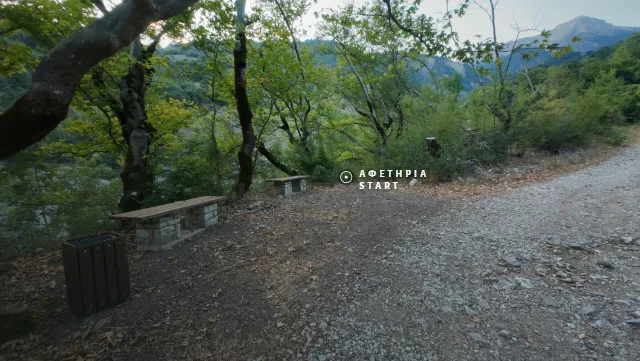
A few meters above the camping area, at the side of the dirt road, you'll find two benches under the plane trees. That's where the path to Kakogefyro begins.
Trail map
The actual GPS track of the path to Kakogefyro. Tap the route on the map for details.